Design evolves. Purpose remains.
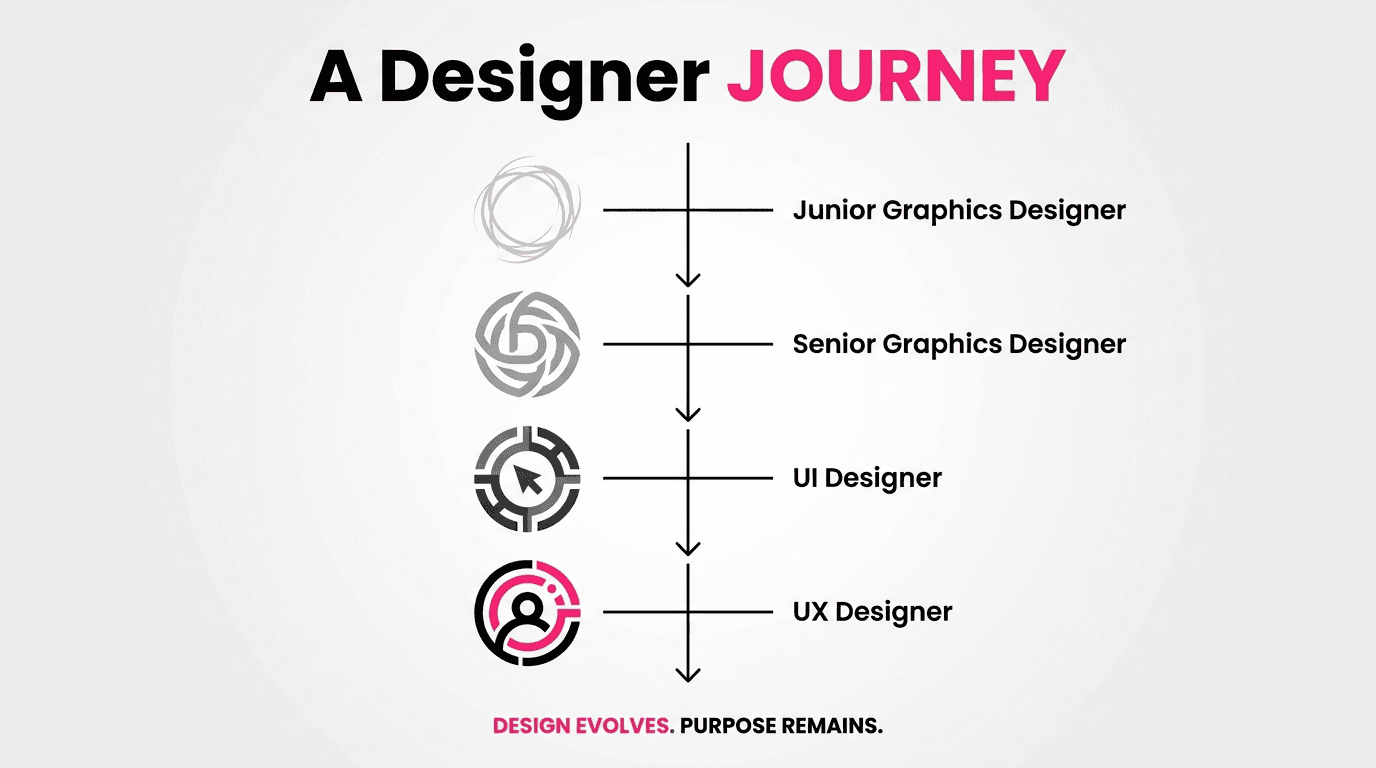
Every designer's career looks like a series of small shifts that only make sense looking backward. Mine started as a Junior Graphics Designer — focused on visuals, layouts, and making things look right. Over time, that role kept evolving, even though the core of what I cared about never really changed: solving problems through design.
Junior Graphics Designer
This is where most of us start — learning tools, understanding brand consistency, and figuring out what makes a design work versus just look nice. It's foundational, even if the work itself is often more execution than strategy at this stage.
Senior Graphics Designer
With experience came more ownership. Design decisions started involving more "why," not just "how." This stage was about refining craft while starting to think beyond the single asset — how does this fit into a bigger system or brand?
UI Designer
The shift into UI design changed how I thought about design entirely. It wasn't just about how something looked anymore — it was about how it worked, how it felt to use, and how consistent it stayed across an entire product. Systems, components, and interaction started to matter as much as visual polish.
UX Designer
The most recent shift — from designing screens to designing experiences. UX pulled the focus further upstream: understanding the problem before touching the interface, mapping user needs, and treating design as a tool for solving real friction, not just decorating a solution.
Why this progression matters
Looking at these four roles side by side, the tools changed, the deliverables changed, the scope changed — but the underlying goal stayed constant: making things clearer, easier, and more useful for the person on the other end.
Design evolves. Purpose remains.